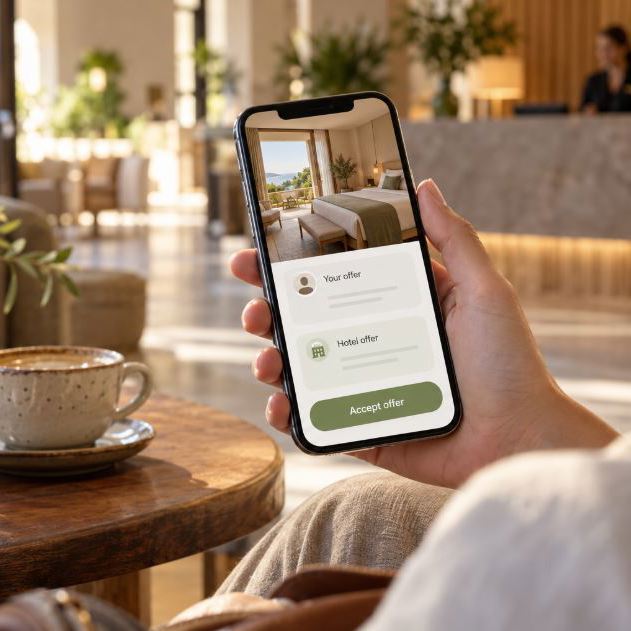
From Scrolling to Negotiating: The Future of Hotel Booking
Think about the last time you booked a hotel.
You probably opened a booking website, entered your destination and dates, scrolled through dozens of options, compared prices, checked photos, read reviews, and finally chose a room.
Online booking has made travel planning much easier. But there's still one thing most platforms have in common: the price is presented to you, and you decide whether to accept it.
What if booking could work differently?
What if, instead of only searching for prices, you could tell a hotel what you're looking for and what you're willing to pay?
That's the idea behind TripleWin.
From finding a price to finding an agreement
The traditional hotel booking process is straightforward:
Search. Compare. Choose. Book.
It works well when the listed price matches your expectations. But when it doesn't, the transaction often ends before the hotel and traveler have any opportunity to find common ground.
A traveler might be ready to book at a slightly lower price. The hotel might be willing to accept that price under the right circumstances. Yet neither side has a clear way to communicate that possibility through an ordinary fixed-price transaction.
TripleWin introduces a different approach:
Express your intent. Make an offer. Receive a response. Decide whether to book.
The traveler communicates the desired stay and proposed price. The hotel evaluates the request and can accept it, counter with another offer, or decline.
It's a simple change in the process, but it creates a new opportunity for agreement.
Why the idea makes sense
Hotel rooms are time-sensitive inventory.
If a room remains empty tonight, the hotel cannot sell that same night's accommodation tomorrow. At the same time, a hotel needs to make sure that the price it accepts supports its business.
Travelers have their own considerations. One person may be willing to pay the public rate, while another may be interested only at a different price.
Neither person is necessarily wrong. They simply value the transaction differently.
TripleWin is designed to help reveal whether there's a price at which both sides are willing to proceed.
Where technology comes in
Negotiating every booking manually would be slow and difficult to scale.
Technology can help structure requests, evaluate relevant information, and connect traveler intent with hotel responses.
As the system processes more negotiations, the resulting information can also help reveal patterns: which types of requests receive responses, how prices vary with demand, and where travelers' offers and hotels' expectations overlap.
Over time, this information can support more informed transaction decisions.
The longer-term vision extends beyond a marketplace where travelers make offers themselves. TripleWin is being built toward a world in which AI assistants can help travelers express their preferences and interact with hotel systems to find suitable, mutually acceptable transactions.
In that future, an AI assistant might do more than recommend a hotel. It could help negotiate the terms of a stay on the traveler's behalf, within the permissions and rules the traveler has set.
This is an emerging direction, not a promise that every booking can already be negotiated autonomously.
A different role in the travel industry
TripleWin isn't designed simply to become another catalogue of hotel rooms.
Its core idea is to introduce a negotiation layer between travelers and accommodation providers.
Booking platforms help people discover and reserve places to stay. Hotel revenue-management systems help properties make pricing decisions. AI travel tools can make planning and recommendations more personalized.
TripleWin focuses on a different question: Can this traveler and this hotel agree on a price that works for both of them?
That question creates value when a fixed public price doesn't lead to a booking, but a mutually acceptable offer might.
What does this mean for you as a traveler?
You don't need to understand AI, pricing algorithms, or hotel revenue management to benefit from a simpler booking experience.
You just need to know what you're looking for and what you're willing to pay.
TripleWin gives you a way to express that offer and lets the hotel respond. If you reach an agreement, you can move forward with the booking under the stated terms.
Not every negotiation will succeed. But the possibility of an agreement gives you another option beyond accepting a price or continuing your search.
The future of booking isn't only about finding the right room. It's about making the right transaction possible.
That's the future TripleWin is working toward, one stay at a time.